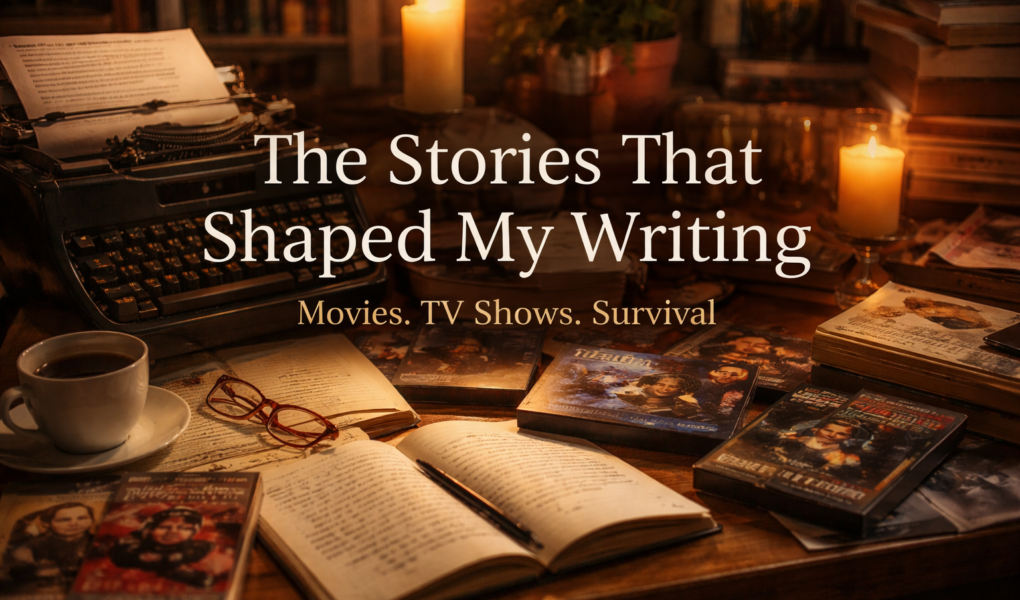
(And Why They’re Not What You Expect)
Someone on TikTok recently tagged me in a challenge, asking which movies and/or TV shows influenced my writing. If you’ve been following my blog for a while, you might already know this about me: I’m a sucker for both movies and TV shows.
So I can already see the expectation forming even before I answer.
Dystopia.
Big concepts.
Worlds ending.
And yes, some of that is true. But the real influences run deeper, quieter, and often more unexpectedly.
What shaped my stories wasn’t just genre. It was how these stories treated identity, survival, and the cost of being seen.
Stories About Survival Under Control
The Handmaid’s Tale
This show taught me that oppression doesn’t have to be loud to be terrifying. Control can be polite. Clean. Ritualized. And the most dangerous thing it takes away isn’t freedom, it’s the ability to talk freely.
That idea echoes strongly in my work: what happens when the world decides who you’re allowed to be, and who you’re not.
Battlestar Galactica
Battlestar Galactica shaped my understanding of moral compromise. It asks brutal questions: Who gets sacrificed for “humanity”? Who decides what survival costs? And how far can you bend your ethics before they break?
Those questions live at the heart of the world I’m writing about in book 2. A world shaped by control, moral compromise, and the stories people tell themselves to survive.
The Hunger Games
Not for the spectacle, but for the surveillance. For the way bodies become battlegrounds and survival turns into performance. Strip away the arena, and what remains is something deeply unsettling.
Strength, Humor, and Found Family
Buffy the Vampire Slayer
Buffy taught me something crucial: strength doesn’t cancel fear. Humor doesn’t erase trauma. You can be scared, angry, exhausted—and still keep going.
That mix of vulnerability and resilience is foundational to how I write my characters.
Firefly
Firefly isn’t really about space. It’s about people doing the wrong things for the right reasons. About loyalty that isn’t noble, just stubborn. About found family in a world where the system has already failed you.
That messy humanity is something I keep coming back to.
Disguises, Gender, and the Cost of Being Seen
Shakespeare in Love
This one surprises people, but it shouldn’t.
Shakespeare in Love isn’t just a romance. It’s about disguises. Gender twists. Confusion as survival. Viola doesn’t pretend for fun. She pretends because the system doesn’t allow her to exist otherwise.
That idea stayed with me. If you’ve read The 23rd Pair, you already know I sneaked in my little dose of Shakespeare in more than one way.
Let’s just say: sometimes disguises aren’t lies. They’re shields.
Quiet Endurance and Emotional Honesty
What’s Eating Gilbert Grape
This film showed me the power of quiet suffering. Responsibility without heroism. Love expressed through endurance rather than grand gestures.
I write caretakers. Survivors. People who stay.
The Usual Suspects
I love stories that trust the audience. That allow misdirection. That let truth arrive sideways. Not everything needs to be explained immediately, sometimes the emotional truth comes first.
Room
Room isn’t horror in the traditional sense. It’s fear through confinement.
What stayed with me was the claustrophobia. The way a single space becomes a whole universe. The way survival depends on routines, stories, and rules that are both protective and imprisoning.
The terror in Room isn’t constant violence. It’s limitation. It’s the narrowing of reality. It’s living inside a system that defines what’s possible, and what isn’t.
That kind of fear shaped how I think about survival. Not as escape fantasies, but as endurance. As adaptation. As the quiet, daily work of staying human in a space designed to shrink you.
What All These Stories Have in Common
At their core, all these stories ask the same questions:
- Who is allowed to exist openly?
- Who has to hide to survive?
- What does it cost to be seen?
- And what parts of ourselves do we protect at all costs?
Those questions are the spine of my writing.
I don’t write about the end of the world. I write about the people who live in it anyway.
Copyright: © Image created through Artbreeder.